We believe that people are key drivers of our sustainability journey. Meghmani ensures a safe, inclusive, and empowering workplace through integrated management systems, fair labour practices, and health surveillance. Our social strategy includes skill development, diversity and inclusion, employee engagement, grievance redressal, and targeted community programs. Contractors and suppliers are aligned with our Code of Conduct and receive ESG / EHS training to ensure shared responsibility. Our efforts are further guided by the principles of the Responsible Care® initiative which emphasize measurable social impact and community well-being through CSR.
Occupational Health and Safety
MOL has adopted Responsible Care management and IMS as a tool to strengthen employee health and safety systems. The quarterly management review governs 40+ Leading indicators, to improve safety culture. Quarterly EHS Management Review Meetings, central safety committees are conducted to evaluate engagements. Safety systems are aligned with ISO 45001 and Responsible Care® principles. OHS frameworks covers essential component such as employee participation, hazard identification, hazard evaluation, operating procedures, training, housekeeping, medical surveillance, health and safety programs, permit-to-work systems, incident reporting and contractor safety. Notably, the organisation has maintained zero fatalities over the last three years, reflecting a strong commitment to creating a safe work environment through continuous engagement and leadership involvement in safety initiative. Across our sites, we operate dedicated occupational health room with qualified medical personnel, periodic health check-ups, and occupational exposure monitoring.
Process Safety Management (PSM)
The PSM framework at Meghmani Organics is guided by the principles of the Centre for Chemical Process Safety (CCPS) and Responsible Care®. Process Safety Management (PSM) ensure the safe handling of hazardous materials through structured risk assessments, and engineering controls. Performance against PSM objectives is reviewed periodically to ensure continuous improvement, this includes key elements like Management of Change (MOC), Pre-Start-up Safety Review (PSSR), and periodic inspections are reviewed against agreed plan of the year. All plant operations are regularly assessed for process safety risks through HAZOP and QRA, compliance review of actions happens on quarterly basis whereas review frequency of HAZOP studies is one in three years. Over the past three years, there have been no significant chemical release incidents at any site. Performance is reviewed periodically against defined PSM objectives to drive continuous improvement and operational integrity.
Operational Risk Management
We address site-level risks through various risk assessment tools such as HIRA, JSA area risk assessment, hazardous reaction control verifications, HAZOP studies. We have implemented quantified and structured monthly engagement scoring system to assess employee involvement in operational risk management activities, this ensures involvement of line management in risk management. We operations risk assessment done through HIRA at the annual frequency.
Emergency Preparedness and Contingency Planning
Our emergency preparedness and response systems include efficient infrastructure, facilities, emergency response and rehearsal procedures supported with trained emergency response team members. Through regular mock drills, cross-functional training, we ensure that our teams are act quickly. Our contingency frameworks are intended to protect people, environment, assets and ensure business continuity and stakeholder confidence during unforeseen events. Emergency preparedness extends beyond physical safety now extended to physical and information security resilience.
Operational Effectiveness / Operational Excellence.
Operational excellence is a strategic imperative driving sustainable growth and stakeholder value creation. We continuously refine our processes—optimising raw material use, enhancing efficiency, reducing energy consumption, and minimising waste. Our approach ensures that productivity and environmental responsibility go hand in hand, reinforcing our commitment to Responsible Care® and long-term sustainability. Our focus areas include contractor safety, energy efficiency, resource conservation, emergency response readiness, and behavioural safety interventions. Through digitalisation, and continuous improvement initiatives, we embed agility, quality, and resilience across our manufacturing. Now, operational excellence at Meghmani is more than meeting targets—it is about creating a future-ready organisation driven by efficiency, accountability, and sustainable performance.
Human Rights & Labour Practices
All forms of child labour, bonded labour, and workplace discrimination are strictly prohibited. Employees have the freedom to associate, raise concerns, and access formal grievance mechanisms. Vendors are expected to comply with the Human Rights & Labour Policy, reinforced through the Supplier Code of Conduct. The policy is aligned with the UN Guiding Principles on Business and Human Rights (UNGPs) and ILO Conventions. A designated committee oversees incident reporting and ensures timely redressal.
Employee Welfare & Engagement
Health insurance, accident insurance, ESI coverage, regular health check-ups, subsidised meals, and transportation facilities are provided to employees. Platforms such as suggestion schemes and grievance redressal mechanisms support open and transparent communication. Employee engagement surveys are conducted periodically, and the results are addressed at the site level. Performance reviews and internal promotion policies are in place to support career growth. Exit interviews and employee feedback gets used to improve systems.
Diversity, Equity & Inclusion (DEI)
Company ensures that hiring, promotions, and leadership opportunities are open to all—regardless of gender, caste, religion, or background. Wage gaps or unequal treatment based on identity are not allowed; pay and recognition depend only on performance and merit. Policies support fairness and inclusion, helping every person feel respected and able to grow. The goal is to build a workplace where everyone has equal chances and is treated with dignity at every level.
Training & Skill Development
We provide job-role-based soft skills, behavioural, technical and EHS related training to all employees and contract workers. Training completion rates are tracked. Skilling programs on process operation, environment, energy, automation, sustainability, and leadership are offered. We have internal goal of covering 100% employees and contract workers in trainings related to his/her job profile. On boarding i.e. Induction training is mandatory before deployment. Skill-building sessions are extended to service providers workforces as part of engagement.
Career Progression Avenues
In line with MOL growth plans, the organisation continuously focuses on attracting, developing and upskilling internal talent. MOL is committed to building skilled teams that can support business expansion and operational excellence. To enable this, career ladders are defined across key roles, clearly outlining how employees can progress based on skills, performance and responsibility. Employees and future leaders feel engaged as they see clear opportunities for growth within the organisation. The career development framework supports continuous learning, role readiness and cross functional movement. At the organisational level, this system strengthens motivation, productivity and retention, while aligning individual career goals with MOL long term business and sustainability objectives.
Responsible Procurement (Social)
In the journey of improvement, we have implemented supplier code of conduct and its policies. We expect suppliers to sign a Supplier Code of Conduct that includes social criteria. We perform assessment on social aspects and share feedback with vendors for improvement, if applicable. We prioritise vendors with local presence and with ethical practices. Supplier performance reviews include social compliance checkpoints. Vendor on boarding includes SAQ as an essential pre-requisite.
Employee Rights & Grievance Redressal
We have a whistle-blower policy available to all stakeholders. Reporting channels are provided both digitally and physically. Zero retaliation is assured for anyone raising a grievance. All complaints are tracked, investigated, and resolved within defined timelines. The Ethics Committee reviews trends and recommends corrective actions.
Customer Experience and Satisfaction
We nurture strategic B2B and B2C relationships in agrochemical and pigment segments through customised formulations, safe product use training, and application-driven support. Our approach includes surveys, complaint resolution, and continual product improvement. In our agrochemical and pigment businesses, we engage with a diverse B2B customer base globally while also strengthening our direct B2C relationships in the domestic agro sector. Our ISO 9001-certified quality management systems, coupled with customer health and safety policies, customer engagement practices aligned with sustainability GRI, frameworks, ensure we meet evolving customer expectations.
CSR Philosophy
Meghmani group always believes in giving something to the society. Any business is directly related to well–being and development of the society in which it is embedded. Meghmani group with the continuous efforts in CSR activities has given lots to its societywith key focus on improvement of Health, Education, social infrastructure, women empowerment specifically in rural areas and fulfils the developmental objectives of neighbouring communities and villages.
CSR Activities
The CSR activities we pursue will be in line with our stated Vision and Mission, focused not just around our plants and offices, but also in other geographies based on the needs of the communities.
- To direct CSR Programmes, inter alia, towards achieving one or more of the following
- Enhancing environmental activity and natural resources;
- Supporting rural development;
- Promoting education by setting up school, colleges and hostels;
- Providing agriculture machineries to under privileged farmers;
- To set up Research & Development Laboratory to carry out Soli testing to enhance production;
- Providing irrigation facility to farmers of the near by vicinity of the plant,
- Providing better seeds to under privileged farmers;
- Providing preventive heaIthcare;
- Providing sanitation and drinking water;
- Creating livelihoods for people, especially those from disadvantaged sections of society, in rural and urban India;
- Preserving and promoting sports;
- To carry out social and cultural activity to uplift standard of living of under privileged
- To develop the required capability and self-reliance of beneficiaries at the grass roots, especially of women, in the belief that these are prerequisites for social, economical and educational development
- To engage in affirmative action interventions such as skill building and vocational – training to enhance employability and generate livelihoods for persons from disadvantaged sections of society
- To pursue CSR Programmes primarily in areas that fall within the economic vicinity of the Company’s operations to enable close supervision and ensure maximum development impact
- Any of the activities as specified in Schedule VII of the Companies Act, 2013.
CSR Committee
The Board of Directors has formulated CSR committee consisting of three members who shall be responsible for monitoring the CSR activities of the Company. The Chairman of Committee is an independent Director. The present CSR Committee comprises of:
- Mr. Manubhai Patel
- Mr. Ankit Patel
- Mr. Karana Patel
- Mr. Darshan Patel
The members of CSR Committee may delegate their powers to such other directors/officer of the Company whom they think are capable of spending the CSR amounts in the activities listed as CSR activities.
The review report on the CSR activities undertaken by the Company shall be placed before the Board of Directors periodically and yearly report shall be approved by the Board of directors in their meeting. MOL shall also include separate reporting in the Annual Report on the implementation of CSR activities / projects.
Appropriate documentation of the MOL CSR Policy, annual CSR activities, executing Partner and expenditure entailed will be undertaken on a regular basis and same will be reported in the Annual Report of the Company.
CSR Reports
 Impact Assessment ReportDownload
CSR Policy
- Download CSR PolicyDownload
Community Engagement & Social Impact
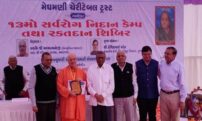
Meghmani Organics is committed to delivering tangible social impact through focused CSR programs in education, healthcare, skill development, and inclusion. Over the past 18 years, our annual mega blood donation drive has mobilised thousands of voluntary donors across rural Gujarat.
We provide free education, meals, and hostel facilities to over 1,500 girls, supporting inclusive growth and female literacy.We are establishing a Skill Development Centre at Dahej-GIDC, aimed at training rural youth for industrial jobs.
More than 200 rural apprentices have benefited from vocational training programs. Contract workers are covered under ESI, PF, and health welfare schemes. We actively collaborate with local panchayats, NGOs, and schools to deliver healthcare camps, distribute aids to differently-abled children, and conduct awareness sessions on legal and health rights.
Our CSR programs are aligned with national priorities and SDGs 3, 4, 5, and 8, and undergone impact assessment to ensure measurable outcome for future planning